3. what is the south pole telescope designed to study?
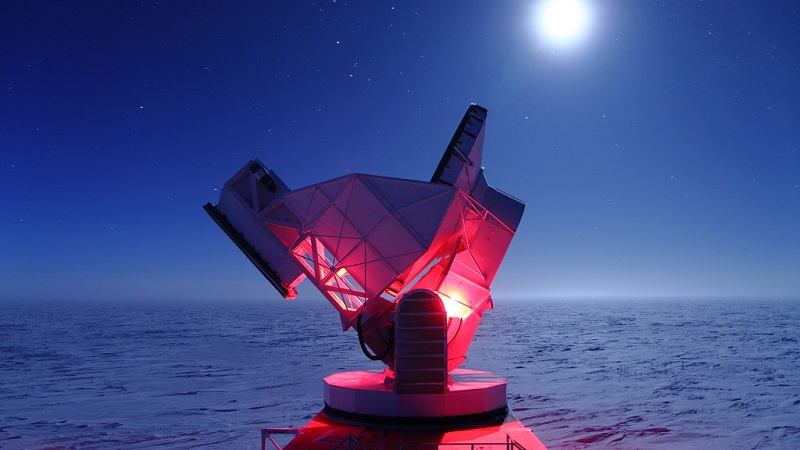
Deep in Antarctica, at the southernmost signal on our planet, sits a 33-pes telescope designed for a single purpose: to make images of the oldest calorie-free in the universe.
This low-cal, known as the catholic microwave background, or CMB, has journeyed across the cosmos for fourteen billion years—from the moments immediately later the Big Bang until now. Because it is brightest in the microwave part of the spectrum, the CMB is incommunicable to see with our eyes and requires specialized telescopes.
The Southward Pole Telescope, specially designed to measure the CMB, has recently opened its third-generation camera for a multi-year survey to observe the primeval instants of the universe. Since 2007, the SPT has shed light on the physics of black holes, discovered a galaxy cluster that is making stars at the highest rate always seen, redefined our picture of when the first stars formed In the universe, provided new insights into night free energy and homed in on the masses of neutrinos. This latest upgrade improves its sensitivity by nearly an society of magnitude—making it amidst the most sensitive CMB instruments ever congenital.
"It's exciting to watch efforts from all over come together to push the frontiers of what we know." — Clarence Chang, Argonne physicist and UChicago professor
"Beingness able to detect and clarify the CMB, especially with this level of detail, is like having a time machine to go dorsum to the first moments of our universe," said University of Chicago Professor John Carlstrom, the chief investigator for the S Pole Telescope project.
"Encoded in images of the CMB low-cal that we capture is the history of what that light has encountered in its 14-billion-year journeying across the cosmos," he added. "From these images, we tin tell what the universe is fabricated up of, how the universe looked when it was extremely young and how the universe has evolved."
Located at the National Scientific discipline Foundation's Amundsen-Scott South Pole Station, the South Pole Telescope is funded and maintained by the National Science Foundation in its function as manager of the U.S. Antarctic Plan, the national program of enquiry on the southernmost continent.
"The ability to operate a ten-meter telescope, literally at the end of the Globe, is a testament to the scientific capabilities of the researchers that NSF supports and the sophisticated logistical support that NSF and its partners are able to provide in ane of the harshest environments on World," said Vladimir Papitashvili, Antarctic astrophysics and geospace sciences plan director in NSF'southward Office of Polar Programs. "This new camera will extend the abilities of an already impressive musical instrument."
The telescope is operated by a collaboration of more than 80 scientists and engineers from a group of universities and U.S. Section of Free energy national laboratories, including three institutions in the Chicago surface area. These research organizations—the University of Chicago, Argonne National Laboratory and Fermi National Accelerator Laboratory—have worked together to build a new, ultra-sensitive camera for the telescope, containing xvi,000 specially manufactured detectors.
"Built with cutting-border detector technology, this new camera will significantly advance the search for the signature of early on catholic inflation in the cosmic microwave background and allow us to make inroads into other key mysteries of the universe, including the masses of neutrinos and the nature of dark energy," said Kathy Turner of DOE's Office of Science.
'Babe pictures' of the cosmos
The CMB is the oldest low-cal in our universe, produced in the intensely hot aftermath of the Large Bang earlier even the formation of atoms. These primordial particles of lite, which have remained nearly untouched for nearly xiv billion years, provide unique clues near how the universe looked at the beginning of time and how it has changed since.
"This relic light is still incredibly bright—literally outshining all the stars that take ever existed in the history of the universe past over an order of magnitude in free energy," said University of Chicago professor and Fermilab scientist Bradford Benson, who headed the effort to build this new photographic camera.
However, because near of the energy is in the microwave part of the spectrum, to observe information technology we demand to utilize special detectors at observatories in high and dry locations. The Due south Pole Station is better than anyplace else on Earth for this: it is located atop a 2-mile thick ice sail, and the extremely depression temperatures in Antarctica mean there is almost no atmospheric water vapor.
Scientists are hoping to plumb this data for information on a number of physical processes and even new particles. "The catholic microwave background is a remarkably rich source for scientific discipline," Benson said. "The third generation camera survey can give us clues on everything from nighttime free energy to the physics of the Big Bang to locating the most massive clusters of galaxies in the universe."
The details of this "baby picture show" of the cosmos will allow scientists to better understand the different kinds of matter and free energy that make up our universe, such as neutrinos and dark energy. They may even find evidence of the gravitational waves from the kickoff of the universe, regarded past many as the "smoking gun" for the theory of inflation. It likewise serves as a rich astronomical survey; one of the things they'll be looking for are some of the beginning massive galaxies in the universe. These massive galaxies are increasingly of interest to astronomers equally "star farms," forming the first stars in the universe, and since they are nearly invisible to typical optical telescopes, the South Pole Telescope is perhaps the most efficient mode to find them.
"Nothing that comes out of a box"
The South Pole Telescope collaboration has operated the telescope since its construction in 2007. Grants from multiple sources—the National Science Foundation, the U.Southward. Department of Energy, and the Kavli and Moore foundations—supported a second-generation polarization-sensitive photographic camera. The latest 3rd-generation focal airplane contains ten times as many detectors every bit the previous experiment, requiring new ideas and solutions in materials and nanoscience.
"From a technology perspective, there is virtually nothing that comes 'out of a box,'" said Clarence Chang, an banana professor at UChicago and physicist at Argonne involved with the experiment.
For the South Pole Telescope, scientists needed equipment far more than sensitive than anything made commercially. They had to develop their ain detectors, which use special materials for sensing tiny changes in temperature when they absorb light. These custom detectors were developed and manufactured from scratch in ultra-clean rooms at Argonne National Laboratory.
The detectors went to Fermilab to be assembled into modules, which included pocket-sized lenses for each pixel made at the University of Illinois at Urbana-Champaign. After being tested at multiple collaborating universities around the country, the detectors fabricated their way back to Fermilab to exist integrated into the South Pole Telescope photographic camera cryostat, designed by Benson. The photographic camera looks similar an 8-pes-alpine, 2,500-pound optical photographic camera with a telephoto lens on the front, only with the added complication that the lenses need to be cooled to just a few degrees to a higher place accented zero. (Even Antarctic isn't that cold, then it needs this special cryostat to absurd it downwardly further.)
Finally, the new camera was set for its 10,000-mile journeying to Antarctica past fashion of land, air and sea. On the last leg, from NSF's McMurdo Station to the Due south Pole, it flew aboard a specialized LC130 cargo plane outfitted with skis so that it could land on snow near the telescope site, since the station sits atop an ice sheet. The components were carefully unloaded, and a team of more than than 30 scientists raced to reassemble the camera during the brief three-month Antarctic summer—since the South Pole is non accessible by plane for nigh of the twelvemonth due to temperatures that can drib to -100° F.
The South Pole Telescope's multi-year observing campaign brings together researchers from across North America, Europe and Commonwealth of australia. With the upgraded telescope taking information, the exploration of the cosmic microwave background radiation enters a new era with a powerful collaboration and an extremely sensitive instrument.
"The study of the CMB involves so many dissimilar kinds of scientific journeys," Chang said. "It's exciting to watch efforts from all over come together to push button the frontiers of what nosotros know."
The Due south Pole Telescope collaboration is led by the Academy of Chicago, and includes research groups at Argonne National Laboratory, Case Western Reserve University, Fermi National Accelerator Laboratory, Harvard-Smithsonian Astrophysical Observatory, Ludwig Maximilian University of Munich, McGill Academy, SLAC National Accelerator Laboratory, University of California at Berkeley, Academy of California at Davis, University of California at Los Angeles, University of Colorado at Boulder, University of Illinois at Urbana-Champaign, Academy of Melbourne, University of Toronto, likewise as individual scientists at several other institutions.
The South Pole Telescope is funded primarily by the National Science Foundation'due south Office of Polar Programs and the U.S. Section of Free energy Office of Science. Partial back up also is provided by the NSF-funded Physics Borderland Center at the KICP, the Kavli Foundation, and the Gordon and Betty Moore Foundation.
This article was originally published by Fermi National Accelerator Laboratory.
Source: https://www.anl.gov/article/nextgeneration-camera-for-the-south-pole-telescope-takes-data-of-early-universe
0 Response to "3. what is the south pole telescope designed to study?"
Post a Comment