Which Statements About Decorative Arts Is True in West Africa
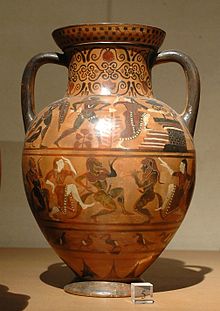
Etruscan: Diomedes and Polyxena, from the Etruscan amphora of the Pontic group, c. 540–530BCE – From Vulci


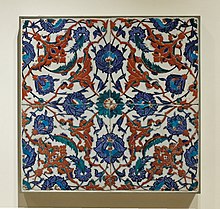
16th century Turkish Iznik tiles, which would have originally formed part of a much larger grouping
Ceramic art is fine art made from ceramic materials, including clay. It may take forms including creative pottery, including tableware, tiles, figurines and other sculpture. As one of the plastic arts, ceramic art is one of the visual arts. While some ceramics are considered fine fine art, such as pottery or sculpture, most are considered to be decorative, industrial or applied art objects. Ceramics may too be considered artefacts in archaeology. Ceramic art can be made by one person or by a group of people. In a pottery or ceramic factory, a group of people design, industry and decorate the art ware. Products from a pottery are sometimes referred to as "art pottery".[one] In a one-person pottery studio, ceramists or potters produce studio pottery.
The give-and-take "ceramics" comes from the Greek keramikos (κεραμεικός), meaning "pottery", which in turn comes from keramos (κέραμος) significant "potter's clay".[2] Most traditional ceramic products were made from dirt (or dirt mixed with other materials), shaped and subjected to heat, and tableware and decorative ceramics are generally still made this mode. In modernistic ceramic engineering science usage, ceramics is the art and science of making objects from inorganic, not-metal materials by the action of heat. It excludes glass and mosaic made from drinking glass tesserae.
There is a long history of ceramic art in almost all developed cultures, and often ceramic objects are all the artistic bear witness left from vanished cultures, similar that of the Nok in Africa over 2,000 years ago. Cultures especially noted for ceramics include the Chinese, Cretan, Greek, Persian, Mayan, Japanese, and Korean cultures, too equally the modern Western cultures.
Elements of ceramic art, upon which different degrees of emphasis take been placed at different times, are the shape of the object, its decoration by painting, etching and other methods, and the glazing found on most ceramics.
Materials [edit]
Different types of dirt, when used with different minerals and firing weather, are used to produce earthenware, stoneware, porcelain and bone red china (fine china).
- Earthenware is pottery that has not been fired to vitrification and is thus permeable to h2o.[3] Many types of pottery have been made from it from the earliest times, and until the 18th century information technology was the almost common type of pottery exterior the far East. Earthenware is oft made from clay, quartz and feldspar. Terracotta, a type of earthenware, is a clay-based unglazed or glazed ceramic,[4] where the fired trunk is porous.[5] [6] [7] [viii] Its uses include vessels (notably blossom pots), h2o and waste water pipes, bricks, and surface embellishment in building construction. Terra cotta has been a common medium for ceramic fine art (see below).
- Stoneware is a vitreous or semi-vitreous ceramic made primarily from stoneware clay or not-refractory fire clay.[9] Stoneware is fired at high temperatures.[10] Vitrified or not, it is nonporous;[eleven] it may or may non be glazed.[12] One widely recognised definition is from the Combined Nomenclature of the European Communities, a European manufacture standard states "Stoneware, which, though dense, impermeable and hard enough to resist scratching past a steel bespeak, differs from porcelain because it is more opaque, and normally only partially vitrified. It may be vitreous or semi-vitreous. It is usually coloured grey or brownish because of impurities in the clay used for its manufacture, and is normally glazed."[eleven]
- Porcelain is a ceramic material made by heating materials, by and large including kaolin, in a kiln to temperatures between 1,200 and ane,400 °C (2,200 and two,600 °F). The toughness, force and translucence of porcelain, relative to other types of pottery, arises mainly from vitrification and the formation of the mineral mullite within the body at these loftier temperatures. Properties associated with porcelain include low permeability and elasticity; considerable strength, hardness, toughness, whiteness, translucency and resonance; and a high resistance to chemical attack and thermal shock. Porcelain has been described equally being "completely vitrified, hard, impermeable (even earlier glazing), white or artificially coloured, translucent (except when of considerable thickness), and resonant". However, the term porcelain lacks a universal definition and has "been applied in a very unsystematic way to substances of various kinds which have simply certain surface-qualities in common".[13]
- Bone china (fine people's republic of china) is a type of soft-paste porcelain that is composed of os ash, feldspathic material, and kaolin. It has been divers every bit ware with a translucent body containing a minimum of thirty% of phosphate derived from brute os and calculated calcium phosphate.[11] [ clarification needed ] Developed by English potter Josiah Spode, bone china is known for its loftier levels of whiteness and translucency,[fourteen] and very high mechanical strength and chip resistance.[xv] Its loftier strength allows information technology to be produced in thinner cross-sections than other types of porcelain.[14] Like stoneware it is vitrified, but is translucent due to differing mineral properties.[16] From its initial development and up to the later part of the twentieth century, bone china was well-nigh exclusively an English production, with production being effectively localised in Stoke-on-Trent.[15] Most major English firms made or still brand it, including Mintons, Coalport, Spode, Royal Crown Derby, Regal Doulton, Wedgwood and Worcester. In the United kingdom, references to "china" or "porcelain" can refer to os china, and "English porcelain" has been used as a term for it, both in the UK and effectually the world.[17] Fine prc is not necessarily bone people's republic of china, and is a term used to refer to ware which does not incorporate os ash.[eleven]
Surface treatments [edit]

Painting [edit]
Red china painting, or porcelain painting is the ornamentation of glazed porcelain objects such every bit plates, bowls, vases or statues. The body of the object may be hard-paste porcelain, developed in China in the 7th or 8th century, or soft-paste porcelain (oft os china), developed in 18th-century Europe. The broader term ceramic painting includes painted ornament on lead-glazed earthenware such as creamware or tin-glazed pottery such as maiolica or faience. Typically the body is showtime fired in a kiln to convert it into a hard porous biscuit. Underglaze ornamentation may then exist applied, followed by ceramic glaze, which is fired and so it bonds to the body. The glazed porcelain may then exist decorated with overglaze painting and fired over again at a lower temperature to bond the paint with the glaze. Decoration may exist applied past brush or past stenciling, transfer press, lithography and screen press.[xviii]
Slipware [edit]
Slipware is a type of pottery identified by its chief decorating process where slip is placed onto the leather-difficult clay torso surface earlier firing past dipping, painting or splashing. Slip is an aqueous interruption of a clay body, which is a mixture of clays and other minerals such as quartz, feldspar and mica. A coating of white or coloured slip, known every bit an engobe, tin can be practical to the article to better its appearance, to requite a smoother surface to a rough body, mask an inferior colour or for decorative effect. Slips or engobes can also be applied past painting techniques, in isolation or in several layers and colours. Sgraffito involves scratching through a layer of coloured skid to reveal a different colour or the base body underneath. Several layers of slip and/or sgraffito can be done while the pot is however in an unfired state. I colour of slip can exist fired, before a second is applied, and prior to the scratching or incising decoration. This is particularly useful if the base of operations body is non of the desired color or texture.[xix]
Terra sigillata [edit]

In sharp contrast to the archaeological usage, in which the term terra sigillata refers to a whole class of pottery, in gimmicky ceramic fine art, 'terra sigillata' describes only a watery refined slip used to facilitate the burnishing of raw clay surfaces and used to promote carbon fume effects, in both primitive depression temperature firing techniques and unglazed alternative western-way Raku firing techniques. Terra sigillata is also used as a brushable decorative colourant medium in college temperature glazed ceramic techniques.[20]
Forms [edit]
Studio pottery [edit]
Studio pottery is pottery made past apprentice or professional artists or artisans working lonely or in pocket-size groups, making unique items or short runs. Typically, all stages of industry are carried out by the artists themselves.[21] Studio pottery includes functional wares such every bit tableware, cookware and non-functional wares such every bit sculpture. Studio potters can be referred to as ceramic artists, ceramists, ceramicists or as an creative person who uses clay every bit a medium. Much studio pottery is tableware or cookware only an increasing number of studio potters produce non-functional or sculptural items. Some studio potters now prefer to call themselves ceramic artists, ceramists or simply artists. Studio pottery is represented by potters all over the earth.
Tile [edit]


Tile, Hopi Pueblo (Native American), belatedly 19th–early on 20th century
A tile is a manufactured piece of hard-wearing material such as ceramic, stone, metallic, or even glass, generally used for roofing roofs, floors, walls, showers, or other objects such as tabletops. Alternatively, tile can sometimes refer to like units made from lightweight materials such as perlite, wood, and mineral wool, typically used for wall and ceiling applications. In another sense, a "tile" is a structure tile or similar object, such as rectangular counters used in playing games (run into tile-based game). The discussion is derived from the French give-and-take tuile, which is, in turn, from the Latin give-and-take tegula, meaning a roof tile composed of fired clay.
Tiles are oftentimes used to form wall murals and flooring coverings, and can range from simple square tiles to complex mosaics. Tiles are most often fabricated of ceramic, typically glazed for internal uses and unglazed for covering, merely other materials are likewise ordinarily used, such as glass, cork, concrete and other composite materials, and rock. Tiling stone is typically marble, onyx, granite or slate. Thinner tiles tin be used on walls than on floors, which require more durable surfaces that will resist impacts.
Figurines [edit]

A figurine (a diminutive form of the word figure) is a statuette that represents a human, deity, legendary animal, or animal. Figurines may be realistic or iconic, depending on the skill and intention of the creator. The primeval were made of rock or clay. In ancient Greece, many figurines were made from terracotta (come across Greek terracotta figurines). Modernistic versions are made of ceramic, metallic, glass, forest and plastic. Figurines and miniatures are sometimes used in lath games, such as chess, and tabletop function playing games. Old figurines take been used to discount some historical theories, such every bit the origins of chess.
Tableware [edit]
Tableware is the dishes or dishware used for setting a table, serving food and dining. Information technology includes cutlery, glassware, serving dishes and other useful items for applied equally well every bit decorative purposes.[22] [23] Dishes, bowls and cups may be made of ceramic, while cutlery is typically made from metal, and glassware is frequently made from glass or other non-ceramic materials. The quality, nature, variety and number of objects varies co-ordinate to civilization, religion, number of diners, cuisine and occasion. For instance, Middle Eastern, Indian or Polynesian food culture and cuisine sometimes limits tableware to serving dishes, using bread or leaves as individual plates. Special occasions are usually reflected in college quality tableware.[23]
Terra cotta (artworks) [edit]
In addition to being a fabric, "terracotta" also refers to items fabricated out of this cloth. In archaeology and art history, "terracotta" is often used to describe objects such as statures, and figurines non fabricated on a potter's bike. A prime number example is the Terracotta Army, a collection of man-sized terracotta sculptures depicting the armies of Qin Shi Huang, the start Emperor of Cathay. It is a form of funerary fine art buried with the emperor in 210–209BCE and whose purpose was to protect the emperor in his afterlife.[24]
French sculptor Albert-Ernest Carrier-Belleuse fabricated many terracotta pieces, simply possibly the most famous is The Abduction of Hippodameia depicting the Greek mythological scene of a centaur kidnapping Hippodameia on her hymeneals day. American architect Louis Sullivan is well known for his elaborate glazed terracotta ornament, designs that would have been incommunicable to execute in any other medium. Terra cotta and tile were used extensively in the town buildings of Victorian Birmingham, England.
History [edit]
There is a long history of ceramic art in nearly all developed cultures, and oftentimes ceramic objects are all the artistic bear witness left from vanished cultures, like that of the Nok in Africa over three,000 years agone.[25] Cultures especially noted for ceramics include the Chinese, Cretan, Greek, Persian, Mayan, Japanese, and Korean cultures, besides equally the modernistic Western cultures. There is evidence that pottery was independently invented in several regions of the world, including Eastern asia, Sub-Saharan Africa, the Almost Eastward, and the Americas.
Paleolithic pottery (c. 20,000 BP) [edit]

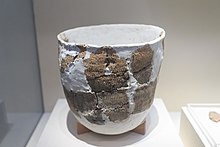
twenty,000-10,000 yr old pottery with re-construction repairs constitute in the Xianrendong cave, China.[26] [27] [28]
Although pottery figurines are found from earlier periods in Europe, the oldest pottery vessels come from East Asia, with finds in China and Japan, then still linked by a state bridge, and some in what is now the Russian Far E, providing several from 20,000–10,000BCE, although the vessels were simple utilitarian objects.[29] [xxx] Xianrendong Cavern in Jiangxi province contained pottery fragments that date dorsum to twenty,000 years ago.[31] [32] These early pottery containers were fabricated well before the invention of agriculture, past mobile foragers who hunted and gathered their food during the Late Glacial Maximum.[27] Many of the pottery fragments had scorch marks, suggesting that the pottery was used for cooking.[27]
Before Neolithic pottery: stone containers (12,000–6,000 BC) [edit]
Many remarkable containers were fabricated from rock before the invention of pottery in Western Asia (which occurred around 7,000 BC), and before the invention of agronomics. The Natufian culture created elegant stone mortars during the period betwixt 12,000 and 9,500 BC. Effectually 8000 BC, several early on settlements became experts in crafting cute and highly sophisticated containers from stone, using materials such as alabaster or granite, and employing sand to shape and polish. Artisans used the veins in the fabric to maximize visual effect. Such object have been constitute in abundance on the upper Euphrates river, in what is today eastern Syria, especially at the site of Bouqras.[33] These form the early stages of the development of the Art of Mesopotamia.
-

Stone mortar from Eynan, Natufian period, 12,500-9,500 BC
-
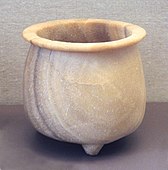
Calcite tripod vase, mid-Euphrates, probably from Tell Buqras, 6,000 BC, Louvre Museum AO 31551
-

Alabaster pot Mid-Euphrates region, half dozen,500 BC, Louvre Museum
-

Alabaster pot, Mid-Euphrates region, 6,500 BC, Louvre Museum
Neolithic pottery (half dozen,500–3,500 BC) [edit]

Early pots were made past what is known as the "coiling" method, which worked the clay into a long string that wound to form a shape that after made smooth walls. The potter's bike was probably invented in Mesopotamia past the 4th millennium BCE, but spread across about all Eurasia and much of Africa, though it remained unknown in the New Earth until the arrival of Europeans. Decoration of the clay by incising and painting is plant very widely, and was initially geometric, but often included figurative designs from very early on.
And so important is pottery to the archeology of prehistoric cultures that many are known by names taken from their distinctive, and often very fine, pottery, such as the Linear Pottery culture, Chalice culture, Globular Amphora civilisation, Corded Ware civilization and Funnelbeaker culture, to have examples but from Neolithic Europe (approximately 7000–1800BCE).
Ceramic art has generated many styles from its own tradition, just is oftentimes closely related to contemporary sculpture and metalwork. Many times in its history styles from the unremarkably more prestigious and expensive fine art of metalworking take been copied in ceramics. This can be seen in early Chinese ceramics, such as pottery and ceramic-wares of the Shang Dynasty, in Ancient Roman and Iranian pottery, and Rococo European styles, copying contemporary silverware shapes. A common use of ceramics is for "pots" - containers such as bowls, vases and amphorae, as well as other tableware, simply figurines have been very widely made.
Ceramics as wall ornament [edit]

The earliest testify of glazed brick is the discovery of glazed bricks in the Elamite Temple at Chogha Zanbil, dated to the 13th century BCE. Glazed and coloured bricks were used to brand low reliefs in Aboriginal Mesopotamia, most famously the Ishtar Gate of Babylon (c. 575BCE), now partly reconstructed in Berlin, with sections elsewhere. Mesopotamian craftsmen were imported for the palaces of the Persian Empire such every bit Persepolis. The tradition connected, and after the Islamic conquest of Persia coloured and oft painted glazed bricks or tiles became an important element in Farsi architecture, and from in that location spread to much of the Islamic world, notably the İznik pottery of Turkey under the Ottoman Empire in the 16th and 17th centuries.
Using the lusterware engineering, i of the finest examples of medieval Islamic apply of ceramics as wall ornament can be seen in the Mosque of Uqba besides known as the Great Mosque of kairouan (in Tunisia), the upper office of the mihrab wall is adorned with polychrome and monochrome lusterware tiles; dating from 862 to 863, these tiles were most probably imported from Mesopotamia.[34] [35]
Transmitted via Islamic Iberia, a new tradition of Azulejos adult in Spain and especially Portugal, which by the Baroque period produced extremely large painted scenes on tiles, commonly in blue and white. Delftware tiles, typically with a painted design roofing only one (rather small) tile, were ubiquitous in the Netherlands and widely exported over Northern Europe from the 16th century on. Several 18th-century imperial palaces had porcelain rooms with the walls entirely covered in porcelain. Surviving examples include ones at Capodimonte, Naples, the Royal Palace of Madrid and the nearby Regal Palace of Aranjuez.[36] Elaborate cocklestoves were a characteristic of rooms of the middle and upper-classes in Northern Europe from the 17th to 19th centuries.
There are several other types of traditional tiles that remain in manufacture, for example, the small, nearly mosaic, brightly coloured zellige tiles of Morocco. With exceptions, notably the Porcelain Tower of Nanjing, tiles or glazed bricks do not feature largely in East Asian ceramics.
Regional developments [edit]
Although pottery figurines are found from earlier periods in Europe, the oldest pottery vessels come from Eastern asia, with finds in China and Japan, then still linked past a land span, and some in what is now the Russian Far East, providing several from between 20,000 and 10,000 BCE, although the vessels were simple utilitarian objects.[29] [thirty] Xianrendong Cavern in Jiangxi province independent pottery fragments that appointment back to 20,000 years ago.[31] [32]
Kingdom of cambodia [edit]
Contempo archaeological excavations at Angkor Borei (in southern Cambodia) take recovered a large number of ceramics, some of which probably date back to the prehistoric period. Well-nigh of the pottery, however, dates to the pre-Angkorian period and consists mainly of pink terra cotta pots which were either hand-made or thrown on a bike, and then busy with incised patterns.
Glazed wares offset appear in the archaeological tape at the end of the 9th century at the Roluos temple grouping in the Angkor region, where green-glazed pot shards accept been plant. A brownish glaze became popular at the commencement of the 11th century and brownish-glazed wares have been constitute in affluence at Khmer sites in northeast Thailand. Decorating pottery with animal forms was a pop fashion from the 11th to 13th century. Archaeological excavations in the Angkor region have revealed that towards the end of Angkor period production of indigenous pottery declined while there was a dramatic increment in Chinese ceramic imports.
Directly evidence of the shapes of vessels is provided by scenes depicted on bas-reliefs at Central khmer temples, which also offer insight into domestic and ritualistic uses of the wares. The wide range of utilitarian shapes suggest the Khmers used ceramics in their daily life for cooking, nutrient preservation, carrying and storing liquids, as containers for medicinal herbs, perfumes and cosmetics.[37]
China [edit]

Chinese Longquan celadon, Song Dynasty, 13th century. Celadon was first made in Prc, and and then exported to various parts of Asia and Europe. Celadon became a favourite of various kings and monarchs, such equally the Ottoman Sultans, because of its pristine beauty, its resemblance to Chinese jade, and the belief that the celadon would change its color if the food or wine were poisoned.[38]
There is Chinese porcelain from the late Eastern Han period (100–200CE), the Iii Kingdoms period (220–280CE), the Six Dynasties period (220–589CE), and thereafter. People's republic of china in item has had a continuous history of large-scale production, with the Purple factories commonly producing the best work. The Tang Dynasty (618 to 906CE) is especially noted for grave goods figures of humans, animals and model houses, boats and other goods, excavated (usually illegally) from graves in large numbers.
Some experts believe the first true porcelain was fabricated in the province of Zhejiang in Communist china during the Eastern Han catamenia. Shards recovered from archaeological Eastern Han kiln sites estimated firing temperature ranged from ane,260 to i,300 °C (2,300 to 2,370 °F).[39] As far back as chiliad BCE, the so-called "porcelaneous wares" or "proto-porcelain wares" were fabricated using at least some kaolin fired at loftier temperatures. The dividing line betwixt the 2 and true porcelain wares is not a clear one. Archaeological finds accept pushed the dates to as early as the Han Dynasty (206–BCE – 220CE).[40]
The Imperial porcelain of the Song Dynasty (960–1279), featuring very subtle decoration shallowly carved by knife in the clay, is regarded by many government equally the peak of Chinese ceramics, though the big and more than exuberantly painted ceramics of the Ming Dynasty (1368–1644) have a wider reputation.
Chinese emperors gave ceramics as diplomatic gifts on a lavish scale, and the presence of Chinese ceramics no doubt aided the development of related traditions of ceramics in Japan and Korea in particular.
Until the 16th century, small quantities of expensive Chinese porcelain were imported into Europe. From the 16th century onwards attempts were made to imitate information technology in Europe, including soft-paste and the Medici porcelain fabricated in Florence. None was successful until a recipe for hard-paste porcelain was devised at the Meissen mill in Dresden in 1710. Within a few years, porcelain factories sprung upwardly at Nymphenburg in Bavaria (1754) and Capodimonte in Naples (1743) and many other places, ofttimes financed past a local ruler.
Nippon [edit]

Nabeshima plate with iii herons

A celadon incense burner from the Goryeo Dynasty with Korean kingfisher glaze. National Treasure No.95 of South Korea
The earliest Japanese pottery was made around the 11th millennium BCE. Jōmon ware emerged in the 6th millennium BCE and the plainer Yayoi fashion in about the 4th century BCE. This early pottery was soft earthenware, fired at low temperatures. The potter's wheel and a kiln capable of reaching higher temperatures and firing stoneware appeared in the third or 4th centuries CE, probably brought from China via the Korean peninsula.[41] In the 8th century, official kilns in Nihon produced unproblematic, dark-green lead-glazed earthenware. Unglazed stoneware was used every bit funerary jars, storage jars and kitchen pots up to the 17th century. Some of the kilns improved their methodsmil[ clarification needed ] From the 11th to the 16th century, Japan imported much porcelain from Cathay and some from Korea. The Japanese overlord Toyotomi Hideyoshi's attempts to conquer Prc in the 1590s were dubbed the "Ceramic Wars";[ citation needed ] the emigration of Korean potters appeared to be a major cause. One of these potters, Yi Sam-pyeong, discovered the raw material of porcelain in Arita and produced first true porcelain in Nippon.
In the 17th century, conditions in China drove some of its potters into Japan, bringing with them the knowledge to make refined porcelain. From the mid-century, the Dutch Due east Republic of india Company began to import Japanese porcelain into Europe. At this fourth dimension, Kakiemon wares were produced at the factories of Arita, which had much in mutual with the Chinese Famille Verte style. The superb quality of its enamel decoration was highly prized in the Due west and widely imitated by the major European porcelain manufacturers. In 1971 it was declared an important "intangible cultural treasure" past the Japanese government.
In the 20th century, interest in the art of the village potter was revived by the Mingei folk movement led past potters Shoji Hamada, Kawai Kajiro and others. They studied traditional methods in social club to preserve native wares that were in danger of disappearing. Mod masters use ancient methods to bring pottery and porcelain to new heights of achievement at Shiga, Iga, Karatsu, Hagi, and Bizen. A few outstanding potters were designated living cultural treasures (mukei bunkazai 無形文化財). In the sometime capital of Kyoto, the Raku family unit continued to produce the rough tea bowls that had so delighted connoisseurs. At Mino, potters connected to reconstruct the classic formulas of Momoyama-era Seto-type tea wares of Mino, such as Oribe ware. Past the 1990s many master potters worked abroad from aboriginal kilns and made classic wares in all parts of Japan.
Korea [edit]
Korean pottery has had a continuous tradition since simple earthenware from near 8000 BCE. Styles have generally been a distinctive variant of Chinese, and later Japanese, developments. The ceramics of the Goryeo Dynasty (918–1392) and early Joseon white porcelain of the following dynasty are generally regarded as the finest achievements.[42]
Western asia and the Centre East [edit]
Islamic pottery [edit]

From the 8th to 18th centuries, glazed ceramics was important in Islamic art, usually in the form of elaborate pottery,[43] developing on vigorous Persian and Egyptian pre-Islamic traditions in particular. Tin-opacified glazing was developed by the Islamic potters, the first examples found as blue-painted ware in Basra, dating from about the 8th century. The Islamic world had contact with People's republic of china, and increasingly adapted many Chinese decorative motifs. Persian wares gradually relaxed Islamic restrictions on figurative ornament, and painted figuratives scenes became very of import.

Ceramic bowl decorated with slip beneath a transparent coat, Gorgan, 9th century CE, Early Islamic period, National Museum of Islamic republic of iran
Stoneware was also an important craft in Islamic pottery, produced throughout Republic of iraq and Syria by the 9th century.[44] Pottery was produced in Raqqa, Syrian arab republic, in the eighth century.[45] Other centers for innovative ceramics in the Islamic world were Fustat (most modern Cairo) from 975 to 1075, Damascus from 1100 to around 1600 and Tabriz from 1470 to 1550.[46]
The albarello class, a type of maiolica earthenware jar originally designed to hold apothecaries' ointments and dry drugs, was first fabricated in the Islamic Middle East. It was brought to Italian republic by Hispano-Moresque traders; the earliest Italian examples were produced in Florence in the 15th century.
Iznik pottery, made in western Anatolia, is highly busy ceramics whose heyday was the belatedly 16th century under the Ottoman sultans. Iznik vessels were originally made in false of Chinese porcelain, which was highly prized. Under Süleyman the Magnificent (1520–66), need for Iznik wares increased. Subsequently the conquest of Constantinople in 1453, the Ottoman sultans started a programme of building, which used big quantities of Iznik tiles. The Sultan Ahmed Mosque in Istanbul (congenital 1609–16) alone contains twenty,000 tiles and tiles were used extensively in the Topkapi Palace (commenced 1459). As a result of this demand, tiles dominated the output of the Iznik potteries.
Europe [edit]
Early on figurines [edit]
The earliest known ceramic objects are the Gravettian figurines from the Upper Paleolithic catamenia, such as those discovered at Dolní Věstonice in the mod-solar day Czech Republic. The Venus of Dolní Věstonice (Věstonická Venuše in Czech) is a statuette of a nude female person figure dating from some time from 29,000–25,000 BCE.[47] It was made by moulding and and then firing a mixture of dirt and powdered bone.[48] Similar objects in various media found throughout Europe and Asia and dating from the Upper Paleolithic period accept as well been called Venus figurines. Scholars are non agreed equally to their purpose or cultural significance.
The ancient Mediterranean [edit]

Glazed Egyptian faience dates to the third millennium BCE), with painted just unglazed pottery used fifty-fifty earlier during the predynastic Naqada culture. Faience became sophisticated and produced on a big scale, using moulds too modelling, and later on likewise throwing on the wheel. Several methods of glazing were developed, but colours remained largely limited to a range in the blueish-green spectrum.
On the Greek island of Santorini are some of the earliest finds created by the Minoans dating to the tertiary millennium BCE, with the original settlement at Akrotiri dating to the 4th millennium BCE;[49] digging piece of work continues at the principal archaeological site of Akrotiri. Some of the excavated homes contain huge ceramic storage jars known every bit pithoi.
Ancient Greek and Etruscan ceramics are renowned for their figurative painting, especially in the black-effigy and blood-red-figure styles. Moulded Greek terra cotta figurines, especially those from Tanagra, were modest figures, often religious just later including many of everyday genre figures, apparently used purely for decoration.
Ancient Roman pottery, such every bit Samian ware, was rarely as fine, and largely copied shapes from metalwork, but was produced in enormous quantities, and is plant all over Europe and the Eye East, and beyond. Monte Testaccio is a waste product mound in Rome made almost entirely of broken amphorae used for transporting and storing liquids and other products. Few vessels of nifty artistic interest have survived, merely there are very many modest figures, frequently incorporated into oil lamps or similar objects, and frequently with religious or erotic themes (or both together – a Roman speciality). The Romans mostly did not exit grave goods, the best source of ancient pottery, but notwithstanding they exercise not seem to have had much in the way of luxury pottery, unlike Roman glass, which the aristocracy used with gold or silver tableware. The more expensive pottery tended to utilize relief ornament, often moulded, rather than paint. Particularly in the Eastern Empire, local traditions continued, hybridizing with Roman styles to varying extents.
Tin-glazed pottery [edit]

A Hispano-Moresque dish, approx 32 cm (13 in) diameter, with Christian monogram "IHS", decorated in cobalt bluish and gold lustre. Valencia, c. 1430–1500. Burrell Collection

Tin-glazed pottery, or faience, originated in Republic of iraq in the ninth century, from where it spread to Egypt, Persia and Spain before reaching Italy in the Renaissance, Holland in the 16th century and England, France and other European countries shortly after. Important regional styles in Europe include: Hispano-Moresque, maiolica, Delftware, and English Delftware. Past the High Eye Ages the Hispano-Moresque ware of Al-Andaluz was the most sophisticated pottery being produced in Europe, with elaborate ornament. Information technology introduced tin-glazing to Europe, which was developed in the Italian Renaissance in maiolica. Tin-glazed pottery was taken up in the Netherlands from the 16th to the 18th centuries, the potters making household, decorative pieces and tiles in vast numbers,[50] normally with blue painting on a white ground. Dutch potters took tin can-glazed pottery to the British Isles, where it was made between virtually 1550 and 1800. In France, tin-glaze was begun in 1690 at Quimper in Brittany,[51] followed in Rouen, Strasbourg and Lunéville. The evolution of white, or well-nigh white, firing bodies in Europe from the belatedly 18th century, such as Creamware past Josiah Wedgwood and porcelain, reduced the demand for Delftware, faience and majolica. Today, tin oxide usage in glazes finds express use in conjunction with other, lower cost opacifying agents, although information technology is mostly restricted to specialist low temperature applications and use by studio potters,[52] [53] including Picasso who produced pottery using tin can glazes.
Porcelain [edit]
Until the 16th century, small quantities of expensive Chinese porcelain were imported into Europe. From the 16th century onwards attempts were fabricated to imitate it in Europe, including soft-paste and the Medici porcelain made in Florence. In 1712, many of the elaborate Chinese porcelain manufacturing secrets were revealed throughout Europe by the French Jesuit begetter Francois Xavier d'Entrecolles and shortly published in the Lettres édifiantes et curieuses de Chine par des missionnaires jésuites [54] After much experimentation, a recipe for hard-paste porcelain was devised at the Meissen porcelain factory in Dresden soon after 1710, and was on auction by 1713. Within a few decades, porcelain factories sprung upward at Nymphenburg in Bavaria (1754) and Capodimonte in Naples (1743) and many other places, ofttimes financed by a local ruler.
Soft-paste porcelain was made at Rouen in the 1680s, but the first important production was at St.Deject, letters-patent existence granted in 1702. The Duc de Bourbon established a soft-paste mill, the Chantilly porcelain, in the grounds of his Château de Chantilly in 1730; a soft-paste manufacturing plant was opened at Mennecy; and the Vincennes factory was ready up by workers from Chantilly in 1740, moving to larger bounds at Sèvres[55] [56] in 1756. The superior soft-paste made at Sèvres put it in the leading position in Europe in the second half of the 18th century.[57] The first soft-paste in England was demonstrated in 1742, apparently based on the Saint-Cloud formula. In 1749 a patent was taken out on the showtime bone china, afterwards perfected by Josiah Spode. The main English porcelain makers in the 18th century were at Chelsea, Bow, St James's, Bristol, Derby and Lowestoft.
Porcelain was ideally suited to the energetic Rococo curves of the day. The products of these early decades of European porcelain are by and large the well-nigh highly regarded, and expensive. The Meissen modeler Johann Joachim Kaendler and Franz Anton Bustelli of Nymphenburg are maybe the most outstanding ceramic artists of the period. Like other leading modelers, they trained as sculptors and produced models from which moulds were taken.
By the finish of the 18th century owning porcelain tableware and decorative objects had get obligatory amid the prosperous middle-classes of Europe, and in that location were factories in nearly countries, many of which are still producing. Every bit well as tableware, early European porcelain revived the taste for purely decorative figures of people or animals, which had too been a feature of several ancient cultures, frequently equally grave goods. These were still being produced in China as blanc de Chine religious figures, many of which had reached Europe. European figures were almost entirely secular, and shortly brightly and brilliantly painted, often in groups with a modelled setting, and a stiff narrative chemical element (see picture).
Wedgwood and the North Staffordshire Potteries [edit]
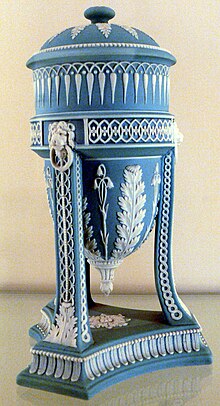
From the 17th century, Stoke-on-Trent in Due north Staffordshire emerged as a major center of pottery making.[58] Important contributions to the development of the industry were made by the firms of Wedgwood, Spode, Royal Doulton and Minton.
The local presence of abundant supplies of coal and suitable clay for earthenware production led to the early on but at first limited development of the local pottery manufacture. The structure of the Trent and Mersey Canal allowed the easy transportation of china dirt from Cornwall together with other materials and facilitated the production of creamware and bone china. Other production centres had a lead in the production of high quality wares just the preeminence of North Staffordshire was brought well-nigh by methodical and detailed enquiry and a willingness to experiment carried out over many years, initially by one man, Josiah Wedgwood. His lead was followed by other local potters, scientists and engineers.
Wedgwood is credited with the industrialization of the manufacture of pottery. His work was of very high quality: when visiting his workshop, if he saw an offending vessel that failed to meet with his standards, he would smash information technology with his stick, exclaiming, "This will non practice for Josiah Wedgwood!" He was keenly interested in the scientific advances of his day and information technology was this interest that underpinned his adoption of its approach and methods to revolutionize the quality of his pottery. His unique glazes began to distinguish his wares from anything else on the market. His matt terminate jasperware in ii colours was highly suitable for the Neoclassicism of the end of the century, imitating the effects of Aboriginal Roman carved gemstone cameos like the Gemma Augustea, or the cameo glass Portland Vase, of which Wedgwood produced copies.
He also is credited with perfecting transfer-printing, first developed in England near 1750. By the end of the century this had largely replaced hand-painting for complex designs, except at the luxury end of the market, and the vast majority of the world's decorated pottery uses versions of the technique to the present day. The perfecting of underglaze transfer printing is widely credited to Josiah Spode the first. The procedure had been used as a development from the processes used in book printing, and early paper quality made a very refined detail in the design incapable of reproduction, so early print patterns were rather lacking in subtlety of tonal variation. The development of machine made thinner printing papers around 1804 allowed the engravers to use a much wider variety of tonal techniques which became capable of being reproduced on the ware, much more successfully.
Far from perfecting underglaze print Wedgwood was persuaded by his painters non to prefer underglaze printing until it became axiomatic that Mr Spode was taking away his business through competitive pricing for a much more heavily decorated high quality product.
Stoke-on-Trent's supremacy in pottery manufacture nurtured and attracted a large number of ceramic artists including Clarice Cliff, Susie Cooper, Lorna Bailey, Charlotte Rhead, Frederick Hurten Rhead and Jabez Vodrey.
Studio pottery in Britain [edit]
Studio pottery is made past artists working alone or in pocket-sized groups, producing unique items or brusk runs, typically with all stages of industry carried out past one individual.[21] It is represented by potters all over the globe but has potent roots in Britain, with potters such every bit Bernard Leach, William Staite Murray, Dora Billington, Lucie Rie and Hans Coper. Bernard Leach (1887–1979) established a style of pottery influenced by Far-Eastern and medieval English forms. Subsequently briefly experimenting with earthenware, he turned to stoneware fired to high temperatures in large oil- or wood-called-for kilns. This style dominated British studio pottery in the mid-20th-century. The Austrian refugee Lucie Rie (1902–1995) has been regarded as essentially a modernist who experimented with new glaze effects on ofttimes brightly coloured bowls and bottles. Hans Coper (1920–1981) produced non-functional, sculptural and unglazed pieces. Later the Second Globe State of war, studio pottery in Britain was encouraged by the wartime ban on decorating manufactured pottery and the modernist spirit of the Festival of Uk. The uncomplicated, functional designs chimed in with the modernist ethos. Several potteries were formed in response to this fifties boom, and this style of studio pottery remained popular into the nineteen-seventies.[59] Elizabeth Fritsch (1940-) took up ceramics working under Hans Coper at the Imperial College of Art (1968–1971). Fritsch was i of a group of outstanding ceramicists who emerged from the Majestic College of Art at that time. Fritschs' ceramic vessels broke abroad from traditional methods and she developed a hand built flattened curlicue technique in stoneware smoothed and refined into accurately profiled forms. They are so hand painted with dry matt slips, in colours unusual for ceramics.
Pottery in Frg [edit]
German pottery has its roots in the alchemistry laboratories searching for gilded product.
- Majestic Porcelain Factory, Berlin
- Meissen porcelain
- Nymphenburg porcelain[lx]
- Hutschenreuther
Pottery in Republic of austria [edit]
In 1718 a pottery was founded in Vienna.[61]
Pottery in Russian federation [edit]
The Imperial Porcelain Manufacture was founded in 1744 in Oranienbaum, Russia.[62] Information technology was based on the invention of porcelain by D. I. Winogradow (independent from Böttgers invention 1708, Dresden). An important drove of antiquarian porcelain is preserved in the Russian Museum of Ceramics.
The Americas [edit]


Anasazi mugs from the Four Corners area, Southwestern US. Note the T-shaped cut-out in the left mug's handle. Bequeathed Puebloan doorways oftentimes have this same shape.
Native American pottery [edit]
The people in Due north, Central, and S America continents had a broad diverseness of pottery traditions before Europeans arrived. The oldest ceramics known in the Americas—made from 5,000 to six,000 years ago—are establish in the Andean region, along the Pacific coast of Ecuador at Valdivia and Puerto Hormiga, and in the San Jacinto Valley of Colombia; objects from 3,800 to 4,000 years old have been discovered in Peru. Some archaeologists believe that ceramics know-how plant its fashion past sea to Mesoamerica, the second bang-up cradle of culture in the Americas.[63]
The best-adult styles found in the central and southern Andes are the ceramics found near the ceremonial site at Chavín de Huántar (800–400BCE) and Cupisnique (1000–400BCE). During the aforementioned menses, some other culture adult on the southern coast of Peru, in the expanse chosen Paracas. The Paracas civilisation (600–100BCE) produced marvelous works of embossed ceramic finished with a thick oil applied later on firing. This colorful tradition in ceramics and textiles was followed by the Nazca culture (1–600CE), whose potters developed improved techniques for preparing clay and for decorating objects, using fine brushes to paint sophisticated motifs. In the early phase of Nazca ceramics, potters painted realistic characters and landscapes.
The Moche cultures (1–800CE) that flourished on the northern coast of modern Republic of peru produced modelled clay sculptures and effigies decorated with fine lines of cherry on a beige background. Their pottery stands out for its huacos portrait vases, in which human faces are shown expressing different emotions—happiness, sadness, anger, melancholy—as well for its complicated drawings of wars, human sacrifices, and celebrations.[64]
The Maya were relative latecomers to ceramic development, equally their ceramic arts flourished in the Maya Archetype Catamenia, or the 2nd to 10th century. Ane of import site in southern Belize is known as Lubaantun, that boasts particularly detailed and prolific works. As prove of the extent to which these ceramic art works were prized, many specimens traced to Lubaantun take been found at distant Maya sites in Republic of honduras and Guatemala.[65] Furthermore, the current Maya people of Lubaantun continue to mitt produce copies of many of the original designs institute at Lubaantun.
In the Us, the oldest pottery dates to 2500BCE. It has been establish in the Timucuan Ecological and Historic Preserve in Jacksonville, Florida, and some slightly older along the Savannah River in Georgia.[66]
The Hopi in Northern Arizona and several other Puebloan peoples including the Taos, Acoma, and Zuñi people (all in the Southwestern U.s.) are renowned for painted pottery in several different styles. Nampeyo[67] and her relatives created pottery that became highly sought after kickoff in the early 20th century. Pueblo tribes in the land of New United mexican states accept styles distinctive to each of the diverse pueblos (villages). They include Santa Clara Pueblo, Taos Pueblo, Hopi Pueblos, San Ildefonso Pueblo, Acoma Pueblo and Zuni Pueblo, amongst others. Some of the renowned artists of Pueblo pottery include: Nampeyo, Elva Nampeyo, and Dextra Quotskuyva of the Hopi; Leonidas Tapia of San Juan Pueblo; and Maria Martinez and Julian Martinez of San Ildefonso Pueblo. In the early 20th century Martinez and her husband Julian rediscovered the method of creating traditional San Ildefonso Pueblo Blackness-on Black pottery.
Mexican ceramics [edit]

Mexican ceramics are an ancient tradition. Precolumbian potters built upwards their wares with pinching, coiling, or hammer-an-anvil methods and, instead of using glaze, burnished their pots.
Studio pottery in the United states of america [edit]
At that place is a potent tradition of studio artists working in ceramics in the Us. It had a period of growth in the 1960s and continues to present times. Many art, craft, and contemporary art museums have pieces in their permanent collections. Beatrice Wood was an American creative person and studio potter located in Ojai, California. She adult a unique form of luster-coat technique, and was agile from the 1930s to her expiry in 1998 at 105 years erstwhile. Robert Arneson created larger sculptural piece of work, in an abstracted representational fashion. In that location are ceramics arts departments at many colleges, universities, and fine arts institutes in the The states.
Sub-Saharan Africa [edit]
It appears that pottery was independently developed in Sub-Saharan Africa during the 10th millennium BC, with findings dating to at least 9,400 BC from key Mali.[68] In Africa, the earliest pottery has been found in the large mountain massifs of the Central Sahara, in the Eastern Sahara, and the Nile Valley, dating back to betwixt the ninth and 10th millennium. [69]
Pottery in Sub-Saharan Africa is traditionally made by coiling and is fired at low temperature. The figurines of the aboriginal Nok civilisation, whose role remains unclear, are an instance of high-quality figural work, plant in many cultures, such as the Republic of benin of Nigeria.
In the Aïr Region of Niger (Westward Africa) (Haour 2003) pottery dating from around 10,000 BCE was excavated.[lxx]
Ladi Kwali, a Nigerian potter who worked in the Gwari tradition, made big pots decorated with incised patterns. Her work is an interesting hybrid of traditional African with western studio pottery. Magdalene Odundo is a Kenyan-built-in British studio potter whose ceramics are paw built and burnished.
Ceramics museums and museum collections [edit]
A ceramics museum is a museum wholly or largely devoted to ceramics, normally ceramic artworks, whose collections may include glass and enamel besides, but will usually concentrate on pottery, including porcelain. Most national ceramics collections are in a more general museum covering all the arts, or just the decorative arts, simply there are a number of specialized ceramics museums, some concentrating on the production of just one country, region or manufacturer. Others accept international collections, which may concentrate on ceramics from Europe or East asia, or have global coverage.
In Asian and Islamic countries ceramics are usually a stiff feature of full general and national museums.[ citation needed ] Also most specialist archaeological museums, in all countries, have large ceramics collections, as pottery is the commonest type of archaeological artifact.[71] About of these are broken shards even so.
Outstanding major ceramics collections in general museums include The Palace Museum, Beijing, with 340,000 pieces,[72] and the National Palace Museum in Taipei metropolis, Taiwan (25,000 pieces);[73] both are mostly derived from the Chinese Regal collection, and are almost entirely of pieces from China. In London, the Victoria and Albert Museum (over 75,000 pieces, mostly after 1400 CE) and British Museum (mostly before 1400 CE) have very strong international collections. The Metropolitan Museum of Art in New York and Freer Gallery of Art in Washington DC (thousands, all Asian[74]) accept perhaps the best of the many fine collections in the big city museums of the United states. The Corning Museum of Drinking glass, in Corning, New York, has more than 45,000 glass objects.
-
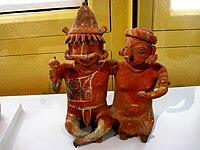
100 BCE – 250 CE
-
-

A funerary urn in the shape of a "bat god" or a jaguar, from Oaxaca, Mexico, dated to 300–650 CE. Top: nine.5 in (23 cm).
-

See too [edit]
- American Museum of Ceramic Art
- List of studio potters
- Sculpture – Artworks that are three-dimensional objects
- Visual arts – Art forms that create works that are primarily visual in nature
References [edit]
Citations [edit]
- ^ "Art Pottery Manufacturers and Collectors". Archived from the original on 2 June 2008. Retrieved 5 January 2003.
- ^ The Webster Encyclopedic Lexicon
- ^ "Earthenware" Britannica online
- ^ OED, "Terracotta"
- ^ 'Diagnosis Of Terra-Cotta Glaze Spalling.' S.Eastward. Thomasen, C.L. Searls. Masonry: Materials, Pattern, Construction and Maintenance. ASTM STP 992 Philadelphia, USA, 1988. American Society for Testing & Materials.
- ^ 'Color Degradation In A Terracotta Glaze' H.J. Lee, W.M. Carty, J.Gill. Ceram.Eng.Sci.Proc. 21, No.ii, 2000, p. 45–58.
- ^ 'High-atomic number 82 glaze compositions and alterations: example of byzantine tiles.' A. Bouquillon. C. Pouthas. Euro Ceramics V. Pt.two. Trans Tech Publications, Switzerland,1997, p. 1487–1490 Quote: "A collection of architectural Byzantine tiles in glazed terra cotta is stored and exhibited in the Fine art Object department of the Louvre Museum besides as in the Musee de la Ceramique de Sevres."
- ^ 'Industrial Ceramics.' F.Singer, S.S.Vocaliser. Chapman & Hall. 1971. Quote: "The lighter pieces that are glazed may also be termed 'terracotta.'
- ^ Standard Terminology of Ceramic Whiteware and Related Products: ASTM Standard C242.
- ^ "What Temperature Should I Burn My Dirt To?". bigceramicstore.com . Retrieved nineteen March 2016.
- ^ a b c d Dodd 1994.
- ^ Encyclopædia Britannica Jasperware is unglazed stoneware
- ^ Definition in The Combined Classification of the European Communities defines, Burton, 1906
- ^ a b Ozgundogdu, Feyza Cakir. "Bone China from Turkey" Ceramics Technical; May2005, Upshot 20, p 29–32.
- ^ a b 'Trading Places.' R.Ware. Asian Ceramics. November,2009, p.35,37-39.
- ^ What is China? As with stoneware, the body becomes vitrified; which means the body fuses, becomes nonabsorbent, and very potent. Unlike stoneware, china becomes very white and translucent. Archived 14 June 2015 at the Wayback Machine
- ^ Osborne, Harold (ed), The Oxford Companion to the Decorative Arts, p. 130, 1975, OUP, ISBN 0-xix-866113-4; Faulkner, Charles H., "The Ramseys at Swan Pond: The Archeology and History of an East Tennessee Farm, p.96, 2008, Univ. of Tennessee Press, 2008, ISBN 1-57233-609-9, 9781572336094; Lawrence, Susan, "Archaeologies of the British: Explorations of Identity in the United kingdom of great britain and northern ireland and Its Colonies 1600–1945", p. 196, 2013, Routledge, ISBN i-136-80192-8, 781136801921
- ^ Lewis, Florence (1883). China painting. Cassell.
- ^ Eden, Victoria and Michael. (1999) Slipware, Contemporary Approaches. A & C Black, University of Pennsylvania Press, G & B Arts International. ISBN 90-5703-212-0
- ^ Garbsch, Jochen, Terra Sigillata. (1982) Ein Weltreich im Spiegel seines Luxusgeschirrs, Munich. (in German)
- ^ a b Cooper 2010.
- ^ Bloomfield, Linda (2013). Gimmicky tableware. London: A. & C. Black. ISBN978-ane-4081-5395-vi.
- ^ a b Venable, Charles L.; et al. (2000). People's republic of china and Glass in America, 1880–1980: From Table Peak to TV Tray. New York: Harry N. Abrams. ISBN978-0-8109-6692-5.
- ^ Portal, Jane (2007). The Showtime Emperor: Communist china'due south Terracotta Army. Harvard Academy Press. ISBN978-0-674-02697-i.
- ^ Breunig, Peter. 2014. Nok: African Sculpture in Archaeological Context: p. 21.
- ^ Huan, Anthony (13 April 2019). "Ancient Mainland china: Neolithic". National Museum of Communist china.
- ^ a b c Bar-Yosef, Ofer; Arpin, Trina; Pan, Yan; Cohen, David; Goldberg, Paul; Zhang, Chi; Wu, Xiaohong (29 June 2012). "Early Pottery at xx,000 Years Ago in Xianrendong Cave, People's republic of china". Science. 336 (6089): 1696–1700. Bibcode:2012Sci...336.1696W. doi:10.1126/science.1218643. ISSN 0036-8075. PMID 22745428. S2CID 37666548.
- ^ Marshall, Michael. "Oldest pottery hints at cooking'southward ice-age origins". www.newscientist.com.
- ^ a b "BBC NEWS – Science & Surroundings – 'Oldest pottery' found in Communist china". bbc.co.uk. June 2009. Retrieved 19 March 2016.
- ^ a b Boaretto, E.; et al. (2009). "Radiocarbon dating of charcoal and bone collagen associated with early pottery at Yuchanyan Cave, Hunan Province, China". Proceedings of the National Academy of Sciences. 106 (24): 9537–9538. Bibcode:2009PNAS..106.9595B. doi:x.1073/pnas.0900539106. PMC2689310. PMID 19487667.
- ^ a b "Harvard, BU researchers find show of xx,000-year-erstwhile pottery". Boston.com. Archived from the original on 2 January 2013. Retrieved 2 Jan 2013.
- ^ a b Stanglin, Douglas (29 June 2012). "Pottery found in China cavern confirmed as earth's oldest". United states of america Today.
- ^ "Metropolitan Museum of Art". www.metmuseum.org.
- ^ Catherine Hess, Linda Komaroff and George Saliba (2004), The arts of fire: Islamic influences on drinking glass and ceramics of the Italian Renaissance, Getty Publications, p. forty
- ^ "Qantara – Mihrāb of the Great Mosque of Kairouan". qantara-med.org. Archived from the original on three March 2016. Retrieved 19 March 2016.
- ^ Porcelain Room, Aranjuez Comprehensive but shaky video [ dead link ]
- ^ "Contact Support". cambodiamuseum.info . Retrieved 19 March 2016.
- ^ Britannica Online Archived 22 December 2007 at the Wayback Machine
- ^ He Li, (1996). Chinese Ceramics. The New Standard Guide. Thames and Hudson, London. ISBN 0-500-23727-one.
- ^ Temple, Robert K.G. (2007). The Genius of Prc: 3,000 Years of Science, Discovery, and Invention (3rd edition). London: André Deutsch, pp. 103–six. ISBN 978-0-233-00202-6
- ^ The Metropolitan Museum of Art [1] "Although the roots of Sueki achieve back to ancient China, its straight precursor is the grayware of the Iii Kingdoms catamenia in Korea."
- ^ "Collection: Korean Art". Freer/Sackler. Smithsonian Institution. Archived from the original on 1 September 2015. Retrieved 2 August 2015.
- ^ Mason, Robert B. (1995). New Looks at Old Pots: Results of Recent Multidisciplinary Studies of Glazed Ceramics from the Islamic Earth. Muqarnas: Annual on Islamic Art and Architecture. Vol. XII. Brill Academic Publishers. ISBN978-xc-04-10314-6. Mason (1995), p. one
- ^ Stonemason (1995), p. 5
- ^ Henderson, J.; McLoughlin, Southward. D.; McPhail, D. Southward. (2004). "Radical changes in Islamic glass technology: evidence for conservatism and experimentation with new glass recipes from early and center Islamic Raqqa, Syrian arab republic". Archaeometry. 46 (3): 439–68. doi:10.1111/j.1475-4754.2004.00167.ten.
- ^ Stonemason (1995), p. 7
- ^ "No. 359: The Dolni Vestonice Ceramics". uh.edu . Retrieved 19 March 2016.
- ^ Chris Stringer. Human Britannicus, Alan Lane, 2006, ISBN 978-0-7139-9795-8.
- ^ "Archaeological site of akrotiri Santorini Greece". travel-to-santorini.com . Retrieved xix March 2016.
- ^ Caiger-Smith, Alan, Can Glazed Pottery, Faber and Faber, 1973
- ^ Faience-de-quimper.com Archived xiii April 2005 at the Wayback Machine
- ^ 'Ceramic Glazes.' F.Singer & West.L.German. Borax Consolidated Limited. London. 1960.
- ^ 'Ceramics Glaze Applied science.' J.R. Taylor & A.C. Balderdash. The Establish Of Ceramics & Pergamon Press. Oxford. 1986.
- ^ Baghdiantz McAbe, Ina (2008). Orientalism in Early Modern France. Oxford: Berg Publishing, p. 220. ISBN 978-1-84520-374-0; Finley, Robert (2010). The pilgrim fine art. Cultures of porcelain in globe history. University of California Press, p. 18. ISBN 978-0-520-24468-ix; Kerr, R. & Wood, N. (2004). Joseph Needham : Science and Civilisation in China, Book 5 Chemistry and Chemical Engineering science : Part 12 Ceramic Engineering science. Cambridge University Printing, p. 36-seven. ISBN 0-521-83833-9
- ^ "The 18th Century: The Rise and Success". Industry nationale de Sèvres. Archived from the original on 24 Nov 2006.
- ^ "Sèvres Porcelain in the Nineteenth Century". The Met'south Heilbrunn Timeline of Art History . Retrieved 19 March 2016.
- ^ "French Porcelain in the Eighteenth Century". The Met's Heilbrunn Timeline of Art History . Retrieved nineteen March 2016.
- ^ "all about Stoke-on-Trent in v minutes..." thepotteries.org . Retrieved nineteen March 2016.
- ^ Harrod, Tanya, "From A Potter's Volume to The Maker's Eye: British Studio Ceramics 1940–1982", in The Harrow Connection, Northern Centre for Contemporary Art, 1989
- ^ "HISTORY Porzellan Manufaktur Nymphenburg". Retrieved 24 July 2016.
- ^ "Porcelain Museum in the Augarten". Retrieved 25 July 2016.
- ^ "Imperial Porcelain: The History of Russian Imperial Porcelain from 1744 to 1917*". Retrieved 25 July 2016.
- ^ The New York Times, Art Review Museum of American Indian's 'Built-in of Clay' Explores Culture Through Ceramics By GRACE GLUECK, Published: i July 2006
- ^ Born of Clay – Ceramic from the National Museum of the American Indian, 2005 Smithsonian Institution
- ^ C.M. Hogan, Comparison of Mayan sites in southern and western Belize, Lumina Technologies (2006)
- ^ Soergel, Matt (18 October 2009). "The Mocama: New name for an onetime people". The Florida Times-Union . Retrieved 12 May 2010.
- ^ A Nampeyo Showcase Archived 24 September 2015 at the Wayback Machine, a display of some of Nampeyo'due south work
- ^ Simon Bradley, A Swiss-led team of archaeologists has discovered pieces of the oldest African pottery in central Republic of mali, dating dorsum to at least 9,400BC Archived 2012-03-06 at the Wayback Machine, SWI swissinfo.ch – the international service of the Swiss Broadcasting Corporation (SBC), 18 Jan 2007
- ^ Jesse, Friederike (25 October 2010). "Early Pottery in Northern Africa – An Overview". Journal of African Archeology. eight (2): 219–238. doi:10.3213/1612-1651-10171. ISSN 1612-1651.
- ^ Olivier P. Gosselain (2008). "Ceramics in Africa". Encyclopaedia of the History of Science, Technology, and Medicine in Non-Western Cultures. pp. 464–476. doi:10.1007/978-ane-4020-4425-0_8911. ISBN978-1-4020-4559-2.
- ^ "Archaeological Analysis", Ohio State Archeological excavations in Greece
- ^ "Palace Museum Opens Its New Porcelain Hall". chinaculture.org. Archived from the original on 3 March 2016. Retrieved xix March 2016.
- ^ "國立故宮全球資訊網-訊息頁". npm.gov.tw . Retrieved 19 March 2016.
- ^ Peterson 1996, p. 369.
Sources [edit]
- Cooper, Emmanuel (2010). Ten Thousand Years of Pottery (quaternary ed.). Philadelphia: University of Pennsylvania Printing. ISBN978-0-8122-3554-8. OCLC 42475956.
- Cooper, Emmanuel (1989). A History of World Pottery. Chilton Book Co. ISBN978-0-8019-7982-8.
- Howard, Coutts (2001). The Art of Ceramics: European Ceramic Blueprint 1500–1830. Yale University Printing. ISBN978-0-300-08387-3. * Cox, Warren (1970). The volume of pottery and porcelain . Crown Publishers. ISBN978-0-517-53931-6.
- Dinsdale, Allen (1986). Pottery Science. Ellis Horwood, Ltd. ISBN978-0-470-20276-0.
- Dodd, Arthur (1994). Dictionary of Ceramics: Pottery, Glass, Vitreous Enamels, Refractories, Clay Building Materials, Cement and Concrete, Electroceramics, Special Ceramics. Maney Publishing. ISBN978-0-901716-56-9.
- Levin, Elaine (1988). The History of American Ceramics: From Pipkins and Edible bean Pots to Gimmicky Forms, 1607 to the present. Harry N. Abrams. ISBN978-0-8109-1172-7.
- Perry, Barbara (1989). American Ceramics: The Collection of Everson Museum of Art . Rizzoli. ISBN978-0-8478-1025-3.
- Peterson, Susan (1996). The arts and crafts and fine art of clay . Woodstock, NY: The Overlook Printing. ISBN978-0-87951-634-5. OCLC 604392596 – via Internet Archive.
- George, Savage; Newman, Harold (2000). Illustrated Lexicon of Ceramics. Thames & Hudson. ISBN978-0-500-27380-seven.
External links [edit]
- Ceramic from the Victoria & Albert Museum
- Ceramic history for potters by Victor Bryant
- Alphabetize to the Metropolitan Museum Timeline of Art History – see "ceramics" for many features
- Minneapolis Establish of Arts: Ceramics – The Art of Asia* Potweb Online catalogue & more than from the Ashmolean Museum
- Stoke-on-Trent Museums – Ceramics Online
- Royal Dutch Ceramics
- U.k. Ceramics Information – British Ceramic Brands
Source: https://en.wikipedia.org/wiki/Ceramic_art
0 Response to "Which Statements About Decorative Arts Is True in West Africa"
Post a Comment