How Many Babies Can a Woman Have in a Lifetime
Did one adult female really give birth to 69 children?
(Paradigm credit:
Getty Images
)
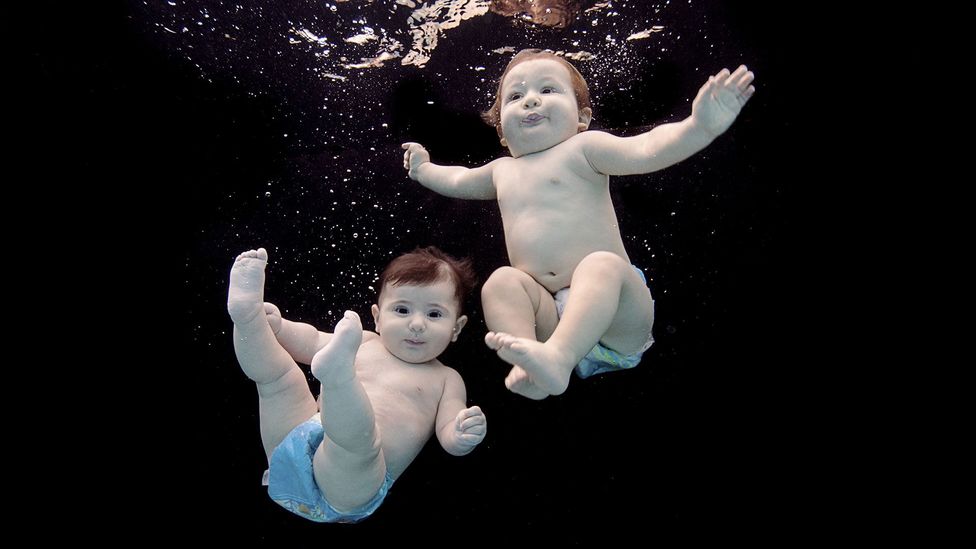
Conceiving and raising one child is demanding plenty – nonetheless historical reports suggest that one woman bore 69. Are they true? And will modern medicine push the limit fifty-fifty farther?
I
If British tabloids had existed in the 18th Century, they would have gone utterly burbling over the family of Russian peasant Feodor Vassilyev.
Why? His first wife – whose name is lost to history – holds the widely cited world record for bearing the near children. Co-ordinate to a local monastery's report to the government in Moscow, between 1725 and 1765 Mrs Vassilyev popped out 16 pairs of twins, seven sets of triplets and four sets of quadruplets, over 27 separate labours. The thousand total: 69 children.
You can only imagine how a present-twenty-four hours newspaper editor would react to such fecundity, especially given the tabloid clamour in recent years over octuplet mother Nadya "Octomom" Suleman, who has fourteen children, or the Radford family unit in United kingdom, which has xvi kids – and a TV show.
And then, is it even possible to birth 60+ children? "It sounds fantastical. I mean, 69 kids? C'monday!" says James Segars, manager of the Sectionalisation of Reproductive Science and Women's Wellness Research at Johns Hopkins University.
I decided to dig a bit deeper into this amazing – and seemingly dubious – claim, by consulting reproduction experts. My promise was to notice the central limits to how many children a woman could always naturally have. Merely along the way, I also discovered that if you take modern science into account, a adult female could, in theory, become the mother to more than children than nosotros ever idea possible.
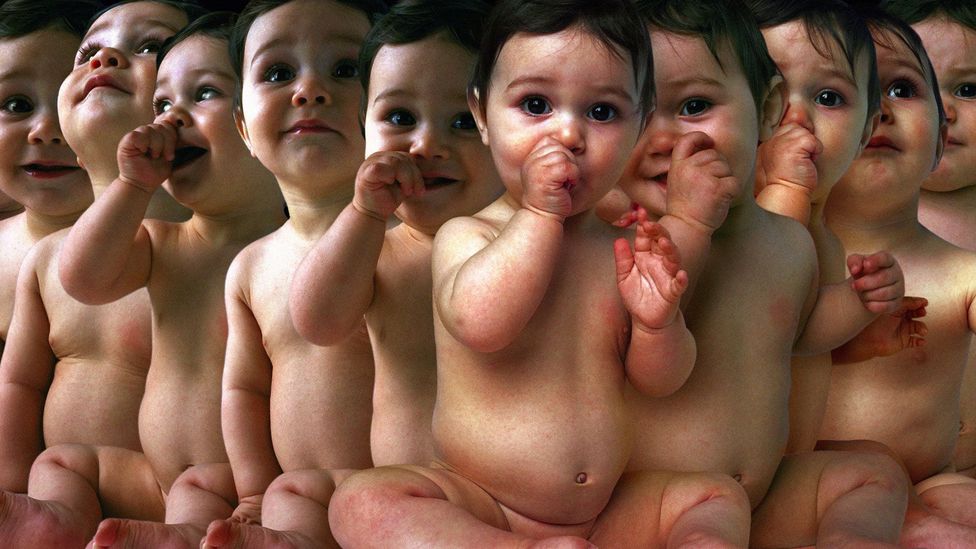
In the U.k., only around 1.five% of pregnancies lead to twins, and every bit for triplets, it'due south a vanishingly small three ten-thousandths of a percentage (Credit: Getty Images)
Start, let's consider the mathematics of the Vassilyev report. Would she have had enough time for 27 pregnancies in the twoscore year-bridge that is claimed? Initially, the respond appears to be yeah, specially if you have into account the fact that triplets and quadruplets are usually birthed afterwards shorter-than-average terms.
Some rough calculations: sixteen twins times 37 weeks; seven triplets times 32 weeks; four quadruplets times 30 weeks. Add it upward, and Mrs Vassilyev would have been pregnant for 18 years of the twoscore years – half of the time, or two-decades-worth of craving pickles and ice cream.
But whether that would be possible in reality is another thing.
For starters, could she have been fertile enough over such a long time period? Women typically go through menarche at around age xv, when their ovaries begin releasing usually a single egg every 28 days. This ovulation continues until the egg supply, insofar equally nosotros know, is wearied at menopause, the typical onset of which is 51 years of historic period.

Most women don't get pregnant by their mid-forties, so would in that location be plenty time to have 69 children? (Credit: Getty Images)
Well earlier menopause, though, women'south fertility plummets. "The pct run a risk of having a baby per cycle when a woman is 45 [years old] is about 1% per calendar month," says Valerie Baker, an associate professor of obstetrics and gynaecology at the Stanford School of Medicine.
As women become older, egg quantity and quality diminish. Halfway through fetal development, unborn females have as many as 7 million young egg cells, but they are born with closer to but one million eggs. Only a few hundred thousand eggs and so persist into machismo. And of these legions, technically known as follicles, something similar 400 e'er mature and eventually ovulate, assuming a thirty-yr span of potential childbearing.
The last of these eggs, ovulated late in a adult female's fertility window, accept far college chances of accruing harm and mutations, such equally chromosomal abnormalities. Many pregnancies with these atypical eggs self-terminate.
"Almost women don't get pregnant by 44, 42 [years of age]," says Segars. "But you'll occasionally hear of people pregnant in their late 40s."
Females are built-in with shut to only one meg eggs, and the number apace dwindles (Credit: Getty Images)
What'south more, the power to become pregnant goes down with each pregnancy, as successive labours have their toll out on a woman'southward reproductive beefcake. And if Mrs Vassilyev were breastfeeding, equally might be expected for a peasant who could not beget to keep wet nurses nigh, her body would non ovulate. This born, biological method of birth command would lengthen the odds even further for her getting pregnant equally often every bit she apparently must take for 69 crumbsnatchers.
Feodor and his married woman, therefore, would have had to exist extremely lucky (or, arguably, unlucky) to have kept striking the mark into her 50s.
Surviving labour
The hurdles for ushering 69 children into the globe inappreciably end at that place, yet. The winding down of a adult female'southward "biological clock" makes a lot of sense from an evolutionary perspective, for conveying and delivering a child is an incredibly difficult task made harder with age.
"Nature would want to make limits," says Baker. "Pregnancy is the well-nigh physically rigorous affair a woman's trunk ever goes through."
The burden of labour is what actually begins to undermine the brownie of Vassilyev'southward 69 children claim – especially considering the setting of hundreds of years ago, out in the Russian countryside.
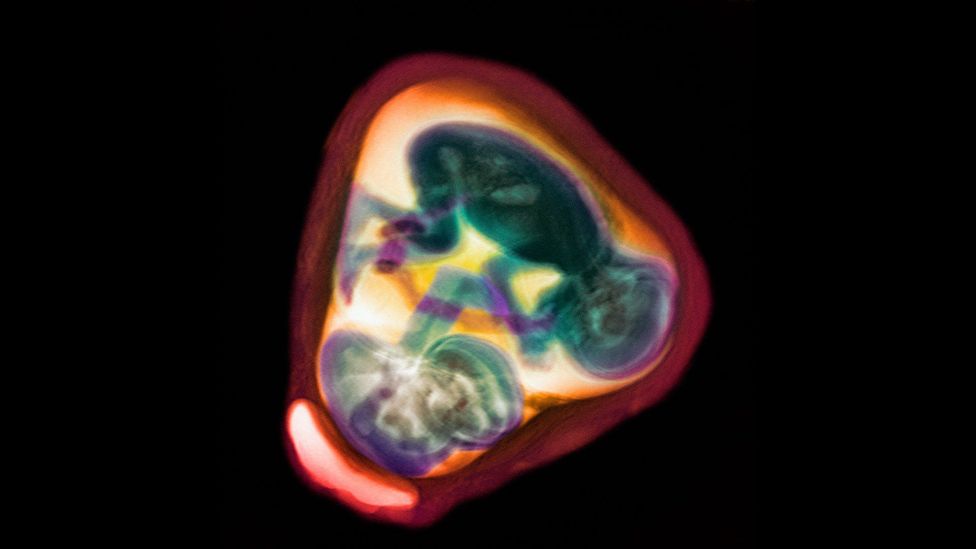
Multiple twins or triplets could in principle permit for high numbers of children, merely the wellness risks are great (Credit: SPL)
In adult nations, modern obstetric care, such as medically necessary caesarean sections, has slashed maternal mortality rates. In the U.k., simply eight women per 100,000 alive births die due to pregnancy-related issues while meaning or inside six weeks of ending a pregnancy, according to the about recent statistics from the Globe Depository financial institution. Meanwhile, in i of the poorest countries on the planet, Sierra Leone, the rate is 1,100 maternal deaths per 100,000 live births.
Bold Mrs Vassilyev survived 27 labours is accordingly dubious. "In the past, every pregnancy was a risk to the mother's life," says Segars. Notably, the risks for serious, deadly complications, such equally hemorrhaging, skyrocket with multiple births such equally quads.
"Every pregnancy dorsum so was a complexity, even a singleton," says Tilly.
An awful lot of nippers
Mrs Vassilyev's multiple conceptions of twins, triplets and quadruplets farther strains brownie. Fetal twins and their more numerous permutations come about in one of two ways: either multiple ovulated eggs are successfully fertilised past sperm – and so-called fraternal twins – or a single fertilised egg divides into ii or more viable embryos, leading to identical twins with the aforementioned genetic code.
Overall, these events are very rare. In the UK in 2012, for instance, the chances of birthing twins stood at just 1.5% of pregnancies; triplets, a vanishingly modest three x-thousandths of a percent, and quadruplets or more, only three instances out of 778,805 maternities, co-ordinate to statistics compiled past the Multiple Births Foundation.
Truthful, a propensity to have twins does run in families, so Feodor'southward wife could arguably accept been just an extreme instance. But overall, the odds for Mrs Vassilyev to have somehow conceived and and so survived the cranking out of 16 twins solitary – let solitary the quads – seem astronomical. "Even just the 16 sets of twins? I'd be shocked," says Jonathan Tilly of Northeastern University, who is investigating oocyte stalk cells for their employ in infertility and women'south health (which nosotros'll hear more than about after on).
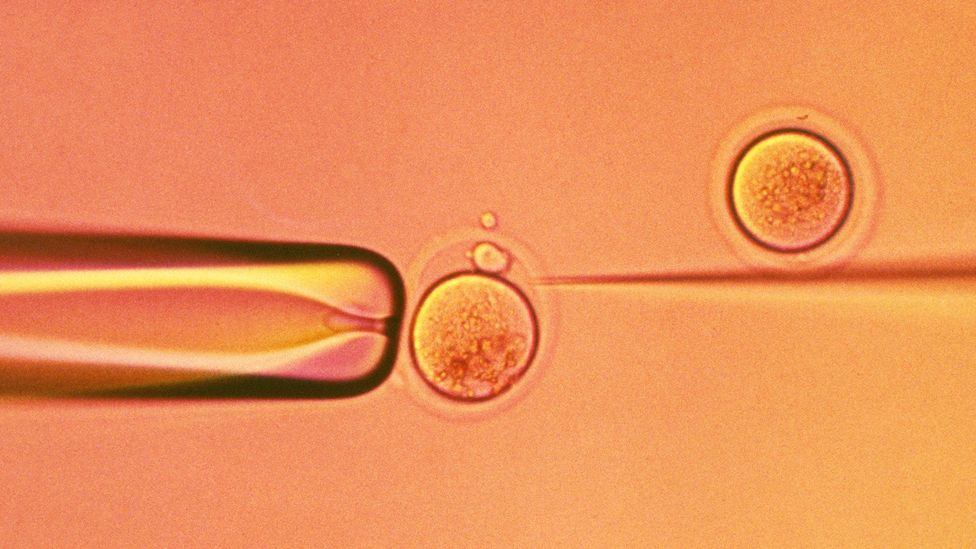
Modern fecundation techniques mean births of countless children could, in theory, be possible (Credit: SPL)
Nevertheless some other red flag in the Vassilyev tale: supposedly 67 of those 69 children survived infancy. Baby mortality was loftier in the 18th Century for total-term singletons, and dismally more so for higher-order births, who are almost always born pre-term and less healthy. "Even if you lot had four sets of quads today, I'm not sure they'd all survive," says Segars.
Finally, there's ane question that beggars belief: what woman would want to practice this? "But think of the stress!" says Baker.
Segars agrees. The last reason he doubts the Vassilyev claim? "Sanity! I couldn't imagine living in that house."
If information technology were true later all, notwithstanding, the daunting childcare duties could exist part of the reason why after decades of marriage, the Vassilyev couple split upward. Old homo Feodor took a second wife, who allegedly had "merely" 18 children. Talk about tabloid fodder.
Brave new world
So what is the bodily limit? Answering that question today is complicated because the "natural" limits to offspring from an individual woman no longer strictly apply.
For starters, assisted reproductive technologies (ART) developed in the late 1970s has led to a fasten in twins, triplets and so on. ("Octomom" Suleman, for instance, used Fine art.) The fact that surrogate mothers can now acquit the biological fetuses of other people as well potentially increases the maximum number of children possible inside one family unit.
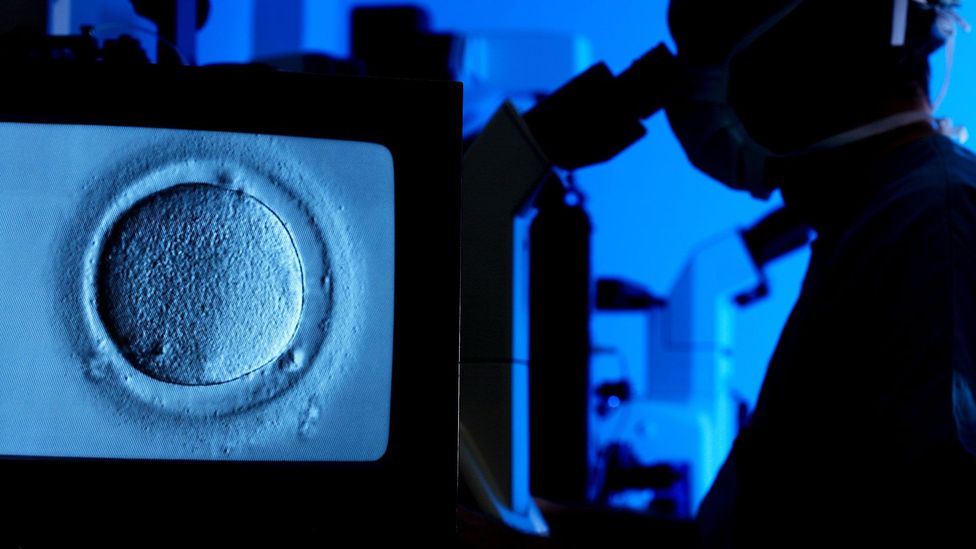
1 researcher believes that it might one day be possible to switch on a adult female's ability to produce vastly more eggs (Credit: SPL)
Merely perhaps most intriguingly, research findings in the last few years hint that the outer limits of female reproduction could be much greater than we can imagine. Recent studies suggest woman's ovaries comprise "oocyte stem cells" that, if properly stimulated, might permit her to produce eggs in near unlimited number.
Tilly and colleagues have documented these cells in creatures ranging from flies to monkeys and, in 2012, humans, too. While oocyte stem cells exercise non produce eggs in humans, they do in other creatures. Female flies make fresh eggs routinely this way.
While many doctors in his field harbour doubts, Tilly believes the machinery in women could, in principle, be switched on, helping women whose existing egg supply is in dire straits or prematurely exhausted from cancer treatment, for instance.
If that hypothetical procedure does turn out to exist possible, consider this farthermost scenario: fertility drugs could exist used to induce ovarian hyperstimulation, wherein multiple follicles mature and ovulate at once. These bunches of eggs could then exist surgically removed and fertilised in vitro, outside the trunk, for subsequent surgical placement into the uterus of an army of surrogate mothers, who would carry the foetus (or foetuses) to term. Each one could potentially take twins – or more.
From a reproductive perspective, and then, women could therefore be more than similar men – with the adequacy of mothering hundreds if not thousands of children, leaving Mrs Vassilyev in the dust.
Tilly makes clear that his inquiry is not in whatever way intended to open the doors to women having thousands of children. The idea is to assistance the fertility of those who are struggling. Nonetheless, he's hopeful it might level the playing field when it comes to fertility across the genders.
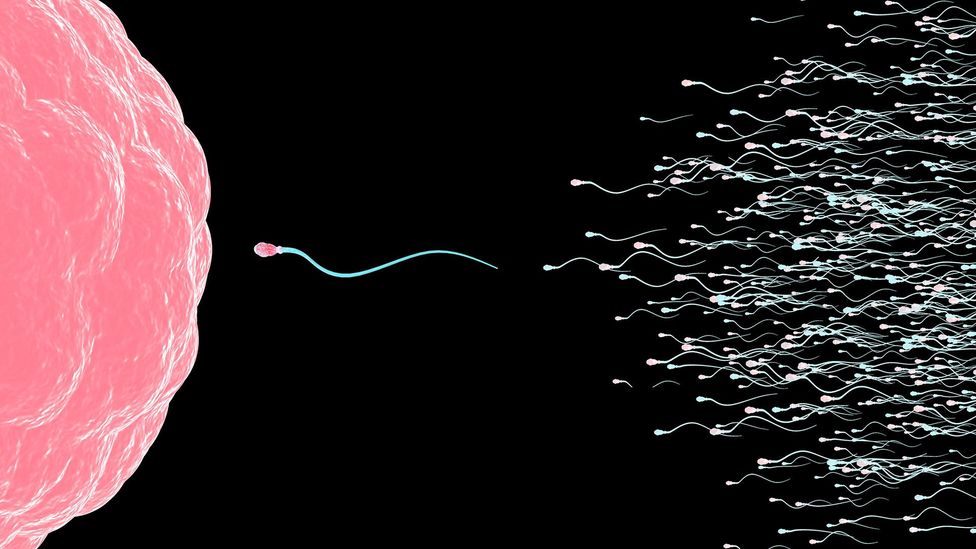
Men can begetter hundreds of children: what if scientific discipline could allow women to practise the aforementioned? (Credit: SPL)
Later on all, homo males produce millions of sperm daily throughout their lives, significant they have essentially no natural limit to how many children they might sire other than bachelor, ovulating partners. The conqueror (and mayhap inveterate rapist) Genghis Khan likely fathered hundreds of children across his continent-of-Asia-spanning empire approximately 800 years ago; genetic prove implies some 16 one thousand thousand people alive today are descended from him.
"Theoretically, men tin male parent children into a very advanced historic period and if they start having children immature, and then you can get the Genghis Khan model," says Tilly. Assuming his inquiry fully pans out, when it comes to practically answering the question of biological progeny, "male fertility doesn't really accept a limit," Lilly says, "and women's doesn't, either."
Conspicuously, this scenario of mothers with countless children would crusade quite a stir if it comes to laissez passer – perhaps even more and then than the 69 children of Mrs Vassilyev. Would a man who fathered scores of children nowadays raise the aforementioned hackles, though, and if non, is that fair?
"People treat unlimited male fertility with a shrug, because anybody knows we can do it," says Tilly. "As soon as we start talking most the infinite possibility of female fertility, though, people get crazy." He feels a sense of perspective should be kept and that the equality women have deservedly sought in recent decades should employ to procreation as well. Says Tilly on the affair: "There really should be no difference between the sexes."
Source: https://www.bbc.com/future/article/20151020-did-one-woman-really-give-birth-to-69-children
0 Response to "How Many Babies Can a Woman Have in a Lifetime"
Post a Comment