Read Chapter 26: Java Web Applications Create an Empty Order Form Using the Code in Page 608 - 611
Certificate Data
Preface
Role I Introduction
1. Overview
2. Using the Tutorial Examples
Part II The Web Tier
three. Getting Started with Spider web Applications
four. JavaServer Faces Technology
5. Introduction to Facelets
6. Expression Language
seven. Using JavaServer Faces Technology in Web Pages
eight. Using Converters, Listeners, and Validators
9. Developing with JavaServer Faces Technology
10. JavaServer Faces Engineering science: Advanced Concepts
11. Using Ajax with JavaServer Faces Technology
12. Composite Components: Advanced Topics and Instance
13. Creating Custom UI Components and Other Custom Objects
14. Configuring JavaServer Faces Applications
15. Java Servlet Technology
16. Uploading Files with Java Servlet Applied science
17. Internationalizing and Localizing Web Applications
Part III Spider web Services
xviii. Introduction to Web Services
xix. Edifice Web Services with JAX-WS
20. Edifice RESTful Web Services with JAX-RS
21. JAX-RS: Avant-garde Topics and Case
Part IV Enterprise Beans
22. Enterprise Beans
23. Getting Started with Enterprise Beans
24. Running the Enterprise Bean Examples
25. A Message-Driven Edible bean Example
26. Using the Embedded Enterprise Edible bean Container
27. Using Asynchronous Method Invocation in Session Beans
Part V Contexts and Dependency Injection for the Coffee EE Platform
28. Introduction to Contexts and Dependency Injection for the Coffee EE Platform
29. Running the Basic Contexts and Dependency Injection Examples
30. Contexts and Dependency Injection for the Java EE Platform: Advanced Topics
31. Running the Advanced Contexts and Dependency Injection Examples
Part Vi Persistence
32. Introduction to the Coffee Persistence API
33. Running the Persistence Examples
34. The Coffee Persistence Query Language
35. Using the Criteria API to Create Queries
36. Creating and Using Cord-Based Criteria Queries
37. Controlling Concurrent Access to Entity Data with Locking
38. Using a 2nd-Level Cache with Java Persistence API Applications
Part VII Security
39. Introduction to Security in the Java EE Platform
40. Getting Started Securing Web Applications
Securing Web Applications
Specifying Security Constraints
Specifying a Web Resource Drove
Specifying an Authorization Constraint
Specifying a Secure Connection
Specifying Security Constraints for Resource
Specifying Authentication Mechanisms
HTTP Basic Authentication
Form-Based Authentication
Digest Authentication
Specifying an Hallmark Machinery in the Deployment Descriptor
Declaring Security Roles
Using Programmatic Security with Web Applications
Authenticating Users Programmatically
Checking Caller Identity Programmatically
Example Code for Programmatic Security
Declaring and Linking Role References
Examples: Securing Web Applications
To Set Up Your Arrangement for Running the Security Examples
The hello2_basicauth Example: Basic Authentication with a Servlet
Specifying Security for Bones Authentication Using Annotations
To Build, Parcel, and Deploy the hello2_basicauth Example Using NetBeans IDE
To Build, Package, and Deploy the hello2_basicauth Case Using Ant
To Run the hello2_basicauth Example
The hello1_formauth Example: Course-Based Authentication with a JavaServer Faces Awarding
Creating the Login Form and the Mistake Page
Specifying Security for the Form-Based Authentication Instance
To Build, Parcel, and Deploy the hello1_formauth Example Using NetBeans IDE
To Build, Packet, and Deploy the hello1_formauth Example Using Ant
To Run the hello1_formauth Example
41. Getting Started Securing Enterprise Applications
42. Java EE Security: Advanced Topics
Part Viii Coffee EE Supporting Technologies
43. Introduction to Java EE Supporting Technologies
44. Transactions
45. Resources and Resource Adapters
46. The Resource Adapter Example
47. Java Message Service Concepts
48. Java Message Service Examples
49. Bean Validation: Avant-garde Topics
50. Using Java EE Interceptors
Part 9 Instance Studies
51. Duke's Bookstore Case Report Case
52. Duke's Tutoring Case Study Example
53. Knuckles's Forest Case Study Example
Index
Overview of Web Awarding Security
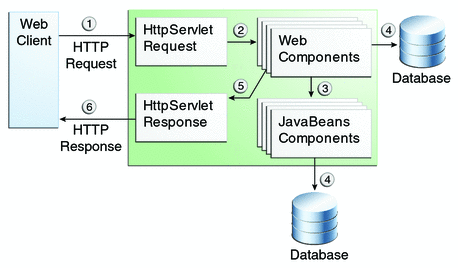
In the Java EE platform, web components provide the dynamic extension capabilities for a web server. Spider web components can be Java servlets or JavaServer Faces pages. The interaction between a web client and a web application is illustrated in Effigy 40-1.
Figure 40-ane Java Web Application Asking Handling
Certain aspects of web application security can be configured when the application is installed, or deployed, to the web container. Annotations and/or deployment descriptors are used to relay information to the deployer about security and other aspects of the application. Specifying this information in annotations or in the deployment descriptor helps the deployer set upward the appropriate security policy for the spider web application. Any values explicitly specified in the deployment descriptor override whatsoever values specified in annotations.
Security for Java EE web applications can be implemented in the post-obit ways.
-
Declarative security: Tin can be implemented using either metadata annotations or an awarding's deployment descriptor. Encounter Overview of Java EE Security for more information.
Declarative security for web applications is described in Securing Spider web Applications.
-
Programmatic security: Is embedded in an application and tin can be used to make security decisions when declarative security alone is non sufficient to express the security model of an application. Declarative security alone may not be sufficient when conditional login in a particular work flow, instead of for all cases, is required in the centre of an application. Encounter Overview of Java EE Security for more data.
Servlet three.0 provides the authenticate, login, and logout methods of the HttpServletRequest interface. With the add-on of the authenticate, login, and logout methods to the Servlet specification, an application deployment descriptor is no longer required for web applications but may still exist used to further specify security requirements beyond the basic default values.
Programmatic security is discussed in Using Programmatic Security with Web Applications
-
Bulletin Security: Works with spider web services and incorporates security features, such equally digital signatures and encryption, into the header of a SOAP bulletin, working in the application layer, ensuring terminate-to-finish security. Message security is non a component of Java EE 6 and is mentioned here for informational purposes only.
Some of the material in this chapter builds on material presented earlier in this tutorial. In particular, this chapter assumes that yous are familiar with the information in the following chapters:
-
Chapter 3, Getting Started with Web Applications
-
Chapter 4, JavaServer Faces Technology
-
Chapter 15, Java Servlet Engineering science
-
Chapter 39, Introduction to Security in the Java EE Platform


Copyright © 2013, Oracle and/or its affiliates. All rights reserved. Legal Notices
Source: https://docs.oracle.com/javaee/6/tutorial/doc/bncat.html
0 Response to "Read Chapter 26: Java Web Applications Create an Empty Order Form Using the Code in Page 608 - 611"
Post a Comment